
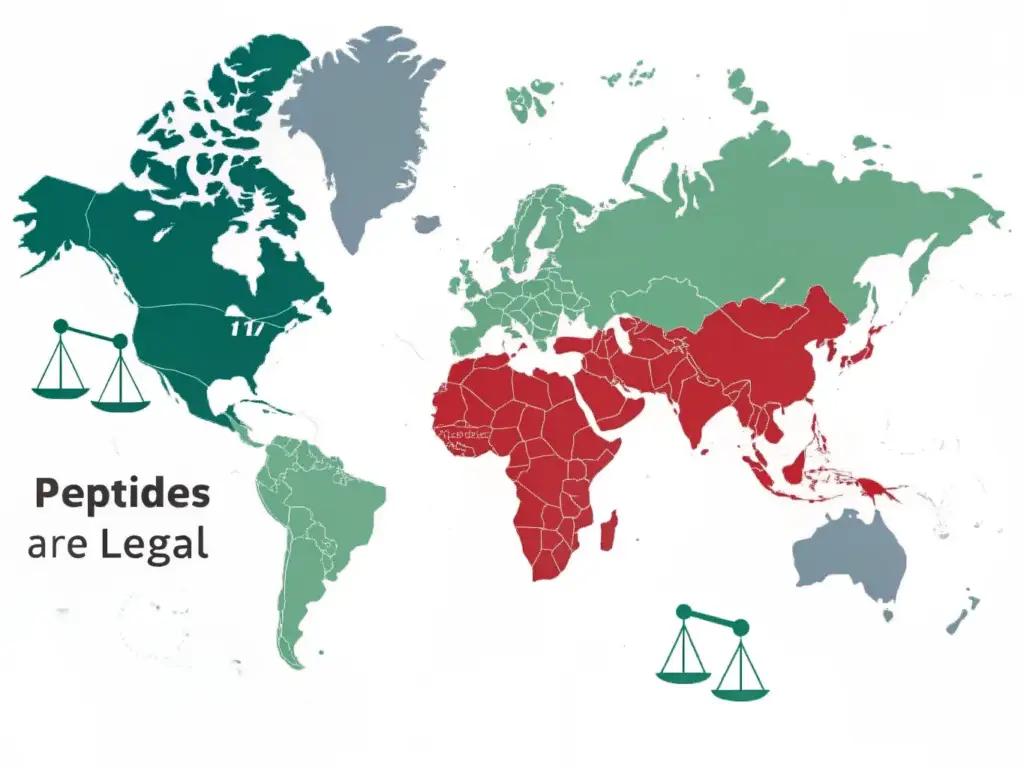
Where Are Peptides Legal?
Peptide legality rarely comes down to the molecule. It comes down to how a product is labeled, marketed, and intended to be used — the same compound can be a lawful lab reagent or an illegal unlicensed medicine depending on the wording around it.
What “research use only” actually means
It is not a disclaimer you paste at the bottom of a page. In the US, UK, and EU it is a regulatory position, and a position only holds if it is true at every touchpoint. Regulators look at the whole presentation: product copy, blog posts, email campaigns, paid ads, published customer reviews, and what a support rep says in a chat window. If any part of that implies human use, the label on the vial does not rescue the product.
In practice, holding the position means labeling every vial “for research use only — not for human consumption,” publishing no human dosing protocols, making no therapeutic claims about healing, recovery, fat loss, or aging, supplying a certificate of analysis with identity and purity data, and steering clear of testimonials or before-and-after imagery describing personal use. Enforcement in this category almost never turns on the compound itself. It turns on the marketing.
United States
Research peptides are not controlled substances. They can be sold for in-vitro laboratory use when labeled research use only, with no human dosing guidance and no therapeutic claims. FDA-approved drugs like semaglutide and tirzepatide need a prescription, and a 2023 FDA action barred compounding pharmacies from using 19 peptides, including BPC-157 and TB-500. That compounding restriction governs clinical access through 503A and 503B pharmacies; it is a separate framework from research-use supply, and the two are constantly confused in headlines.
United Kingdom
Under the Human Medicines Regulations 2012, research peptides are legal to buy and sell as lab materials, and most are not controlled under the Misuse of Drugs Act. Add health claims or human dosing instructions and the product becomes an unlicensed medicine — an offense the MHRA actively enforces, including against sellers whose research-use labels were contradicted by their own marketing.
European Union
Same logic, 27 regulators. Germany’s BfArM reads the medicinal-product definition strictly; southern Europe is looser in practice. GLP-1 compounds draw the heaviest customs scrutiny, because authorized medicines built on the same active substances already exist, which makes any unlicensed version look like a competing unlicensed medicine rather than a reagent.
Canada
Research use is permitted under the Food and Drugs Act; human use requires a DIN. Health Canada issued an April 2026 advisory against unauthorized injectable peptides, and authorized a generic semaglutide the same month — a useful contrast between an approved peptide medicine and an unapproved online product.
Australia — strictest major market
BPC-157 became Schedule 4 (prescription-only) in June 2024, the first such scheduling anywhere. TB-500, CJC-1295, and ipamorelin are also Schedule 4, and Melanotan II moved to Schedule 9 in February 2026. Border Force seizes undocumented shipments, and the TGA has pursued suppliers with penalties in the millions.
Asia, the Middle East, and Latin America
Japan and South Korea apply tight import controls, and unapproved injectables are treated as pharmaceuticals at the border. Singapore’s Health Sciences Authority draws a clear line between institutional research supply and consumer import, and penalties there are severe. China is the manufacturing center of the global peptide trade — most research-grade material anywhere traces back to Chinese synthesis — with export routine and domestic human-use marketing restricted. In the UAE, research supply operates openly while human use runs through Ministry of Health–licensed clinics. Enforcement is lighter in practice across parts of Southeast Asia, Latin America, and Russia, though weak oversight correlates with counterfeit and contamination risk rather than with safety.
Treat all of this as a snapshot. National rules move, and this is not legal advice.
Crossing borders
The destination country’s law governs, not the seller’s. A vial that is perfectly lawful where it ships from can be an unlicensed medicine import where it lands. This is why most established suppliers maintain a no-ship list rather than leaving buyers to discover the problem at customs — Australia, New Zealand, Japan, South Korea, and Singapore appear on nearly all of them.
For legitimate research shipments, documentation is what clears: a commercial invoice describing laboratory reagents, a certificate of analysis identifying the compound and its purity, and labeling consistent with both. GLP-1-class compounds attract more attention than anything else in the category.
Anti-doping is a separate question entirely
Legality and eligibility are different systems, and a compound can pass one while failing the other. The 2026 WADA Prohibited List took effect January 1, 2026. BPC-157 is named as an example under S0, non-approved substances. TB-500 appears under S2.3 as a growth factor. CJC-1295, ipamorelin, and the GHRPs fall under S2.2. All are prohibited at all times, in and out of competition, so there is no off-season. GLP-1 agonists currently sit on WADA’s Monitoring Program rather than the Prohibited List. Anything lawfully purchased for research can still end a tested athlete’s season.
What’s pending
United States. HHS announced in February 2026 that roughly 14 of the 19 restricted peptides would move back to Category 1. In July 2026 the FDA’s Pharmacy Compounding Advisory Committee voted to recommend six — BPC-157, KPV, TB-500, MOTS-c, Semax, and epitalon — for the 503A bulks list, rejecting emideltide. Several votes were narrow and went against the agency’s own reviewers. That is a non-binding recommendation, not a rule; rulemaking can take 12–24 months, the FDA can decline, and nothing is legally compoundable today. Anyone advertising these peptides as FDA-approved or as newly legal for human use is making a false claim.
European Union. The EMA’s guideline on the development and manufacture of synthetic peptides took effect June 1, 2026, tightening expectations for synthesis, characterization, impurity control, and comparability. It targets medicine manufacturers, but it raises the analytical bar the whole supply chain is measured against.
United Kingdom. The MHRA is expected to revisit distribution requirements for novel substances, with peptide marketing already under active investigation.
Australia. The TGA’s April 2026 safety advisory named BPC-157, TB-500, GHK-Cu, CJC-1295, and retatrutide — historically a precursor to more scheduling. The Poisons Standard is updated three times a year, so changes arrive on a predictable calendar.
What to watch
Three signals tend to precede real change: regulator advisories that name specific compounds, scheduling calendars in countries that publish them, and enforcement actions aimed at marketing rather than at molecules. The third is the one most sellers miss, because it means the rules can tighten without a single new law being written.
Research-use status is a regulatory position, not a loophole. It holds only as long as labeling, marketing, and actual use stay inside it.
All products are sold for laboratory research use only. Not for human consumption. This article is general information, not legal advice.