
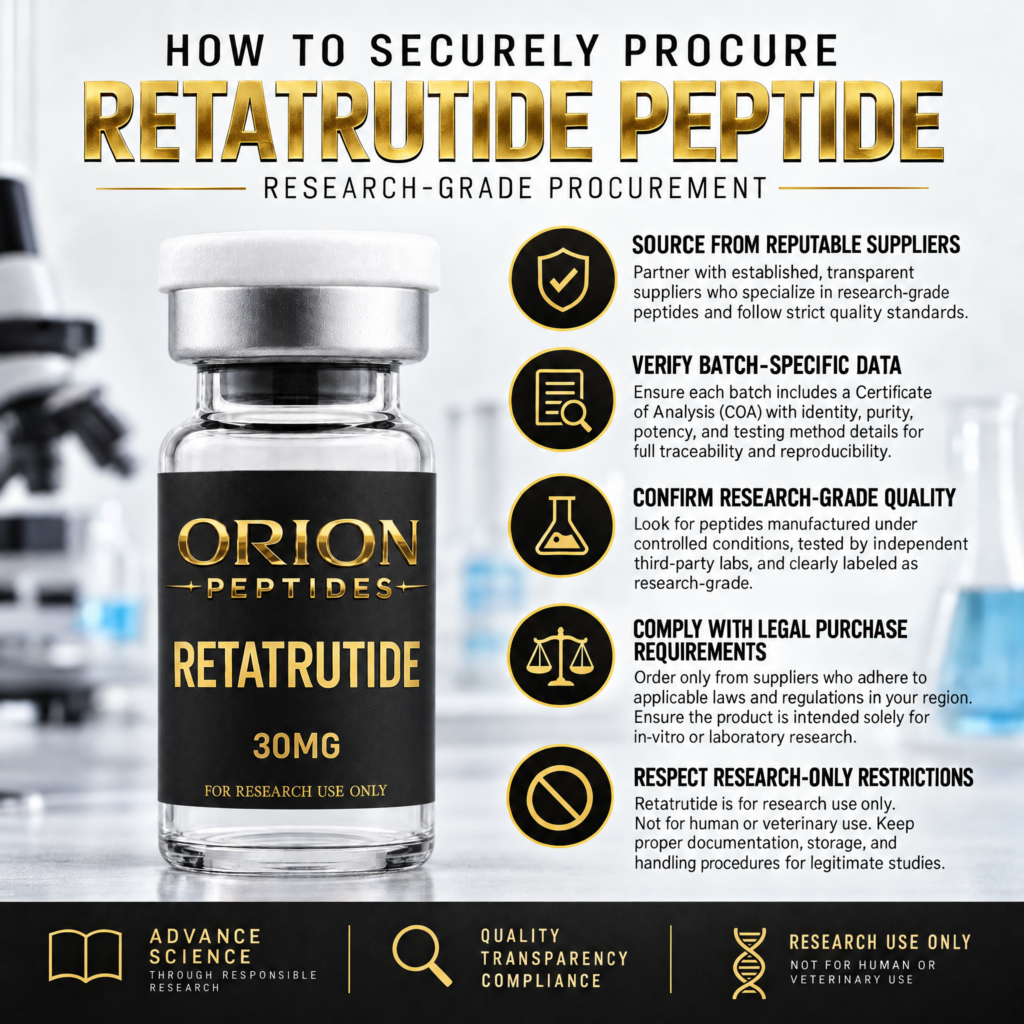
Retatrutide is drawing serious attention in metabolic research because it is a synthetic triple-agonist peptide that engages GIP, GLP-1, and glucagon receptors. For laboratories evaluating a retatrutide peptide for sale, the real decision is not simply whether it is available, but whether the supplier can document identity, purity, lot traceability, and research-only positioning. This guide explains research utility, retatrutide pricing, and the safeguards that separate legitimate procurement from risky online “weight loss” products.
What is retatrutide, and why are researchers studying it?
Retatrutide, also known as LY3437943, is an investigational peptide agonist of the glucose-dependent insulinotropic polypeptide, glucagon-like peptide 1, and glucagon receptors. That triple receptor profile is the core reason retatrutide studies are of interest: researchers can examine how combined incretin and glucagon pathway activity may influence metabolic signaling, energy balance, glucose regulation, and body composition models. In a published phase 2 obesity trial, retatrutide was evaluated as a GIP, GLP-1, and glucagon receptor agonist, and Lilly-sponsored phase 3 studies have continued to evaluate it as an investigational therapy rather than an approved consumer product. (nejm.org)
For research teams, that distinction matters. Retatrutide used as a laboratory reagent is not the same thing as a finished, approved medicine. A qualified lab may look for retatrutide for in vitro assays, receptor signaling work, pharmacology studies, or animal model protocols where the compound is handled under institutional controls and used according to approved research plans.

Research use belongs in controlled laboratory settings
The strongest procurement conversations start with scope: What will the peptide be used for, who will handle it, and what documentation is needed before the material can enter the lab? Retatrutide is typically positioned by research suppliers as a lyophilized peptide for research use only, not for human or veterinary administration. The buyer should be prepared to evaluate the material like any other research reagent, with identity confirmation, purity data, handling requirements, and chain-of-custody records.
A practical research-use workflow often includes:
- Protocol review before purchase Confirm that the planned use is consistent with institutional, biosafety, animal care, and procurement policies.
- Supplier qualification Review the company’s documentation practices, lot numbering, customer support, and willingness to provide batch-specific analytical records.
- Material receipt and inspection Match the vial label, lot number, and Certificate of Analysis before the compound is released for study use.
- Storage under lab SOPs Follow the supplier’s stated storage guidance, commonly involving frozen storage for lyophilized peptide, and document any reconstitution or aliquoting in laboratory records.
- Study-specific controls Use validated procedures, appropriate controls, and qualified personnel so that experimental outcomes are not compromised by handling variability.
Availability in the USA is research-only, not consumer treatment
Searches for “retatrutide for sale usa” can return a confusing mix of legitimate research listings, gray-market ads, and consumer-facing claims. As of September 10, 2026, retatrutide remains an investigational product and is not identified by FDA as an active ingredient in any FDA-approved drug. FDA has also warned that some companies have illegally sold unapproved GLP-1 products containing semaglutide, tirzepatide, or retatrutide while using labels such as “for research purposes” or “not for human consumption” to mask consumer-directed sales. (fda.gov)
That is why researchers should treat online availability carefully. A listing that uses phrases like “reta peptide for sale” or “retatrutide peptide for sale” is not automatically illegitimate, but the page must clearly support research procurement rather than personal use. Red flags include dosage coaching, weight-loss testimonials, injection instructions for consumers, medical claims, subscription “treatment” language, or claims that the product is FDA-approved.
What should a credible retatrutide peptide for sale listing include?
A credible research listing should make verification easy. The strongest suppliers do not rely on vague claims like “high quality” or “lab tested.” They provide batch-specific evidence that a procurement specialist or principal investigator can review before ordering.
Look for these credibility signals:
- Lot-matched Certificate of Analysis with the same lot or batch number shown on the vial or product documentation.
- Analytical identity testing, commonly mass spectrometry or LC-MS, to support that the compound is what the label says it is.
- Chromatographic purity data, commonly HPLC or UPLC, with a clear percentage and method reference.
- Purity specifications near 99% when advertised, without confusing purity with net peptide content or fill weight.
- Transparent vial size and format, such as lyophilized powder, with no implication of consumer administration.
- Research-use-only language that is consistent across the product page, invoice, label, and customer support communications.
- Storage and handling guidance written for laboratories, not for self-medication.
- Responsive documentation support, especially if your institution requires vendor qualification forms, SDS documents, or additional analytical records.
Some current research suppliers publicly advertise retatrutide with HPLC purity specifications, mass spectrometry confirmation, COAs, and multiple vial sizes; examples found in 2026 listings include research-use-only pages citing ≥99% HPLC purity or batch-matched analytical documentation. These listings can help buyers understand the market, but each supplier still needs independent internal review before purchase. (peptoidlabs.com)
How much does retatrutide cost for research procurement?
The answer to “how much is retatrutide” depends on vial size, order volume, documentation level, supplier model, and whether the purchase is retail or wholesale. Public research-market listings observed in 2026 often place small retail 10 mg vials roughly around the high two-digit to low three-digit dollar range, while bulk or wholesale listings may quote much lower per-vial pricing once minimum order quantities are met. For example, one retail research listing showed a 10 mg option around $100 per vial with quantity discounts, while a wholesale supplier advertised retatrutide bulk pricing starting around $15 per 10 mg vial under wholesale minimums. (peptoidlabs.com)
So, how much does retatrutide cost in practice? A small exploratory order may carry a higher unit cost because the supplier is covering low-volume packaging, testing, fulfillment, and support. A larger institutional or distributor-style order may reduce the unit price, but it also raises the stakes: the buyer should insist on batch consistency, documentation, and clear replacement or discrepancy procedures before committing to volume.
Retatrutide pricing should be evaluated as total research value, not just sticker price. A cheaper vial that lacks identity confirmation, lot traceability, or usable COA data can cost more in failed assays, unusable inventory, or compliance review delays. Conversely, a higher price may be reasonable if it comes with stronger analytical documentation, cleaner procurement paperwork, and dependable support.

Retail and wholesale pricing models affect buying strategy
Small labs, pilot projects, and early assay development usually benefit from retail purchasing because it allows the team to test supplier reliability before scaling. The per-vial cost is higher, but the financial exposure is lower. This route can be sensible when the protocol is new, the lab is still optimizing concentrations, or procurement needs a small amount for validation before a larger requisition.
Wholesale purchasing is different. It may appeal to distributors, core facilities, or laboratories running repeated study cycles, but volume discounts are only useful if the material remains consistent and usable across the planned timeline. Before placing a large order, ask whether all vials come from the same lot, whether reserve samples are retained, and whether the supplier can provide stability or retest information when relevant.
A simple buying strategy is:
- Start with the smallest quantity that can support method validation.
- Review whether the COA matches actual delivered labeling.
- Confirm that purity and identity data are understandable to your team.
- Document storage conditions immediately after receipt.
- Scale only after the supplier passes technical and administrative review.
Retatrutide compared with semaglutide and tirzepatide in research context
Retatrutide is often discussed alongside semaglutide and tirzepatide because all three relate to incretin biology, but they are not interchangeable tools. Semaglutide is associated with GLP-1 receptor agonism, while tirzepatide is a dual GIP and GLP-1 receptor agonist. Retatrutide’s distinguishing research feature is its triple activity across GIP, GLP-1, and glucagon receptors, which makes it useful for questions that cannot be answered by studying GLP-1 signaling alone. (nejm.org)
That broader receptor profile can be valuable when researchers want to explore pathway crosstalk, metabolic signaling, or comparative pharmacology. It also means study design needs to be more careful. Controls, comparator compounds, receptor-specific readouts, and model selection become especially important when interpreting effects that may arise from multiple receptor systems.
The legal and safety line is not optional
The biggest mistake in this market is treating research availability as medical availability. Retatrutide sold online for weight loss, personal experimentation, or unsupervised injection is not a legitimate substitute for clinical trial participation or FDA-approved therapy. FDA has issued warning letters involving online peptide sellers and has specifically raised concerns about unapproved GLP-1 drugs marketed for weight loss, including products containing retatrutide. (fda.gov)
For individuals interested in retatrutide as a possible treatment, the appropriate route is not a research chemical website. It is a licensed healthcare professional and, where eligible, a legitimate clinical trial listed through recognized trial channels. For laboratories, the appropriate route is a documented research procurement process that keeps the compound within controlled, non-clinical use.
Key takeaways for responsible sourcing
Retatrutide is a promising research peptide because its triple receptor profile gives scientists a way to study metabolic signaling beyond GLP-1-only models. However, availability does not remove the need for verification. The best procurement decisions balance scientific fit, supplier transparency, analytical documentation, and regulatory caution.
Before you approve a purchase, confirm:
- The product is explicitly limited to legitimate research use.
- The supplier provides lot-specific COA documentation.
- Purity and identity are supported by appropriate analytical methods.
- Pricing makes sense for the quantity, documentation, and risk level.
- The listing does not blur the line between research reagent and human-use product.
If a supplier cannot clearly answer those points, keep looking. Reliable retatrutide research starts before the first assay: it starts with disciplined sourcing, careful documentation, and a firm boundary between laboratory investigation and unapproved human use.