
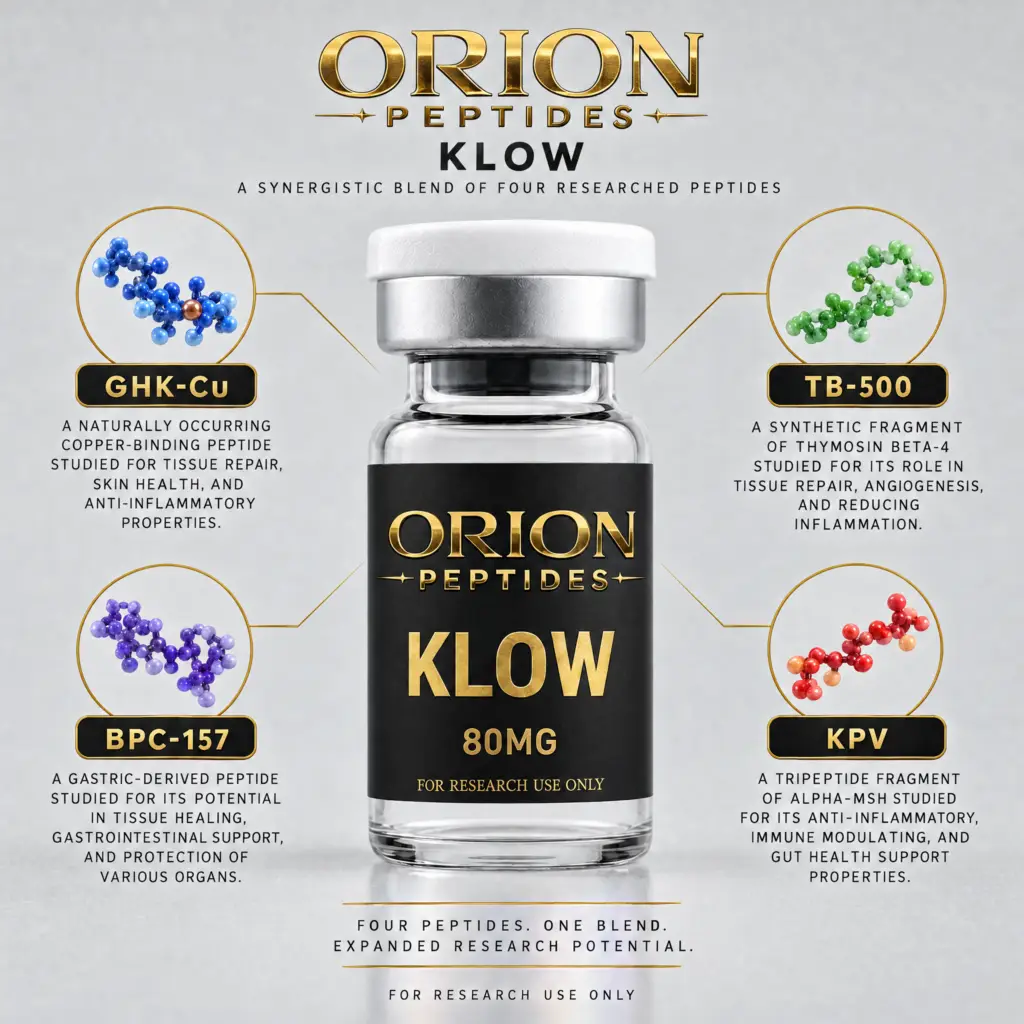
KLOW is not a compound. It is a supplier blend name for a fixed-ratio mixture of four separately studied peptides in one vial: GHK-Cu, BPC-157, TB-500 and KPV.
That distinction shapes everything else on this page. There is no KLOW molecule, no KLOW pharmacology, and no published research on KLOW. There are four component peptides, each with its own literature, combined by vendors into a product. Understanding the blend means understanding the four, and then being clear about what combining them does and does not establish.
Where the name comes from
KLOW is a direct extension of an earlier blend called GLOW, which contains three of the four: GHK-Cu, BPC-157 and TB-500. Adding KPV — the “K” — produces KLOW. The blend is also referred to informally as the “Wolverine stack.”
None of these names appears in published scientific literature. They are commercial and community designations, which has a practical consequence: the name does not define a formula. A vial labelled KLOW tells you which four peptides are probably inside; it does not tell you the ratio, the total mass, or whether a given supplier has substituted or omitted a component.
That is not a hypothetical concern. Published composition figures already disagree. The most commonly cited format is an 80 mg vial at 50 mg GHK-Cu with 10 mg each of BPC-157, TB-500 and KPV. Other sources describe the same 80 mg total with BPC-157 as the 50 mg component instead. Those are materially different products under one name.
The practical rule: read the ingredient panel and the lot-specific analysis, not the nickname.
The four components
GHK-Cu
A naturally occurring tripeptide (glycyl-L-histidyl-L-lysine) complexed with copper, identified in human plasma by Loren Pickart in 1973. It has the deepest literature of the four — roughly five decades — concentrated in skin and connective tissue. Dermal fibroblast studies show enhanced collagen and elastin synthesis at low nanomolar concentrations. Human topical studies, generally small and 12 weeks in length, have reported improvements in skin density, thickness and elasticity.
GHK-Cu is also the component with a favourable regulatory position: topical GHK-Cu was placed in Category 1 of the FDA’s 503A bulk substances list in September 2023, while injectable routes were placed in Category 2.
BPC-157
A synthetic pentadecapeptide derived from a sequence found in gastric juice, studied in preclinical models of tissue repair, wound healing and gastrointestinal protection. The overwhelming majority of the literature is rodent work. Human clinical data is limited, and FDA reviewers characterised the available studies as short and underpowered when the compound came before the Pharmacy Compounding Advisory Committee in July 2026.
TB-500
A synthetic fragment corresponding to a region of thymosin beta-4, a peptide involved in actin regulation and cell migration. Preclinical investigation centres on wound healing and tissue regeneration, with reported effects in skin, corneal and cardiac injury models. Human evidence is thin.
KPV
Lys-Pro-Val, a tripeptide corresponding to the C-terminal fragment of alpha-melanocyte-stimulating hormone. It is the component that distinguishes KLOW from GLOW. Research is concentrated in inflammation: human cell line work and mouse colitis models. It is a biologically interesting addition with a mechanism distinct from the other three, and its human evidence base is the least developed of the four.
What the combination establishes
The rationale offered for the blend is multi-pathway: four peptides acting on overlapping but non-identical mechanisms, with the expectation of additive or synergistic effect.
That is a coherent hypothesis. It has not been tested. No controlled study has evaluated the four-component combination — not in humans, and not, as far as the published record shows, in animals either. There is no study demonstrating that KLOW outperforms GLOW, that the four-way blend outperforms any single component, or that the components do not interfere with one another.
Every claim about KLOW as a blend is an extrapolation from separate studies of its parts. The word “synergy” in this context describes a design intention, not a measured result.
The fixed-ratio limitation
For research purposes this deserves its own heading, because it is a methodological constraint rather than a marketing consideration.
Once four peptides are lyophilised together at a fixed ratio, they cannot be varied independently. Any experiment using the blend varies all four in lockstep. That makes it impossible to attribute an observed effect to any one component, to construct a dose-response curve for a single peptide, or to run a proper control.
A blend is a convenience format. For any research question narrower than “what does this specific mixture do,” separate vials are the methodologically sound choice — and for most questions worth asking, the question is narrower.
Regulatory status
All four components are supplied as research-use-only material. None is an FDA-approved drug for any indication, and neither is the blend.
The regulatory picture is unusually active right now, and all four components are in it:
- BPC-157, TB-500 and KPV were three of the seven peptides reviewed by the FDA’s Pharmacy Compounding Advisory Committee on 23–24 July 2026. The committee voted to recommend all three for inclusion on the 503A Bulks List — BPC-157, KPV and TB-500 each passing 8–6 with one abstention — against FDA staff’s written recommendation to add none of them. Those votes are advisory and non-binding. The FDA must still decide whether to accept them and proceed through notice-and-comment rulemaking, with approval from the Secretary of Health and Human Services also required. As of now, none has been added to the list.
- GHK-Cu was not part of that review. It is scheduled for consideration at a further FDA meeting expected before the end of February 2027, alongside LL-37, dihexa acetate, Melanotan II and PEG-MGF.
The short version: three of the four components have advisory support for a compounding pathway that does not yet exist, and the fourth is awaiting review. None of that constitutes approval, and none of it changes the status of a blended research product.
Sourcing and identity verification
Blends raise a verification problem that single-compound vials do not, and it is the most useful practical content on this page.
Identity testing is harder on a mixture. An HPLC purity figure for a blend describes the sample as a whole. It does not confirm that all four peptides are present, that each is the correct molecule, or that the ratio matches the label. Four components at a 50/10/10/10 split means three of them constitute 12.5% of the mass each — small enough that omission or substitution is not obvious from a total-purity number.
What to ask for:
- A lot-specific certificate of analysis from an independent laboratory, matched to the number on the vial.
- Mass spectrometry confirming the identity of each component, not just aggregate purity. This matters especially for GHK-Cu, which is easily confused with related copper peptides including AHK-Cu and palmitoyl-GHK, and for TB-500, where “TB-500” and full-length thymosin beta-4 are sometimes conflated.
- The stated ratio, in writing, on the ingredient panel — not inferred from the blend name.
Storage. Lyophilised material below −20 °C, protected from light and moisture. The GHK-Cu component adds sensitivity to oxidation and pH. Stability after reconstitution is markedly shorter than in lyophilised form, and a mixture is only as stable as its least stable component.
Summary
KLOW is a convenience format combining four peptides with genuine individual research records, most of it preclinical, in a fixed ratio that no study has validated as a combination. The components are interesting; the blend is a product decision. Anyone evaluating it should assess the four component literatures separately and treat claims about the mixture as untested until a study of the mixture exists.
Provided for research and informational purposes. The compounds described are supplied for laboratory research use only and are not for human or veterinary consumption. None is an FDA-approved drug for any indication. Nothing here is medical advice, and no product described is intended to diagnose, treat, cure or prevent any disease. Regulatory status in this area is actively changing; verify current status before relying on any statement here.
Sources
- Pickart L, Margolina A. Regenerative and Protective Actions of the GHK-Cu Peptide in the Light of the New Gene Data. Int J Mol Sci. 2018.
- FDA, 503A bulk drug substances list, September 2023 Category 1 and Category 2 designations.
- FDA, Pharmacy Compounding Advisory Committee meeting, 23–24 July 2026. Docket FDA-2025-N-6895.
- Reporting on PCAC outcomes and vote tallies: AJMC, NCPA, Buchanan Ingersoll & Rooney, McDermott Will & Emery.