
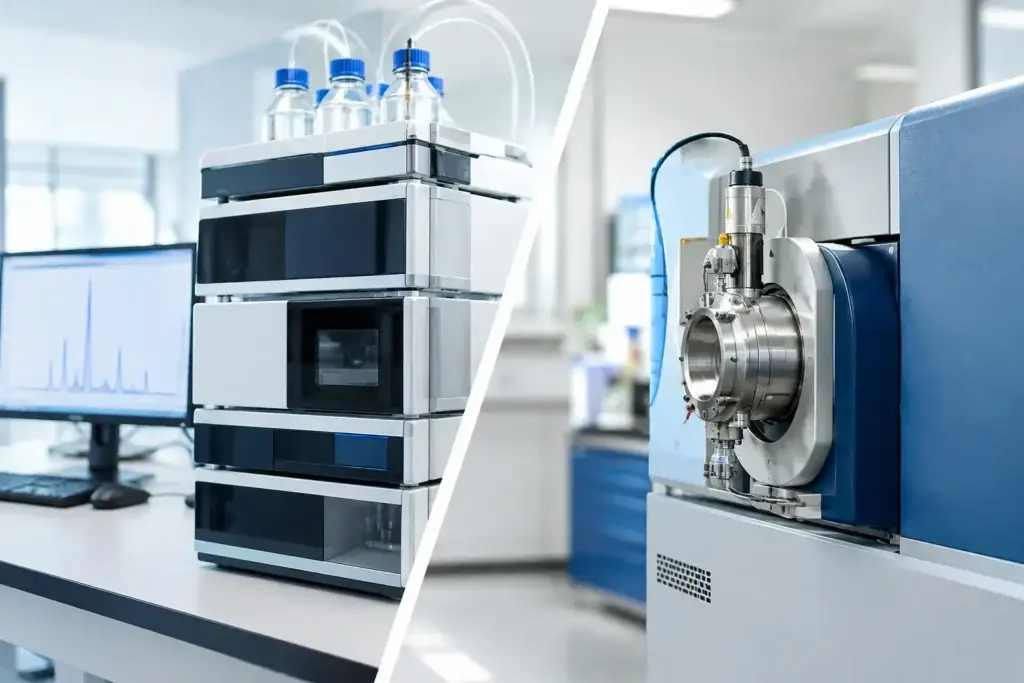
A peptide vial can look identical across suppliers while representing very different analytical confidence. That is why HPLC versus peptide mass spectrometry is not a choice between a basic and an advanced test. Each method answers a different question about the material in front of you. For laboratories evaluating research peptides, the useful standard is not a single impressive number. It is documentation that connects the tested batch, the analytical method, and the reported result.
HPLC versus peptide mass spectrometry: the core difference
High-performance liquid chromatography, or HPLC, separates components in a sample before they reach a detector. In peptide quality control, reverse-phase HPLC is commonly used to produce a chromatogram with peaks representing components that elute at different times. The area of the main peak, relative to the total integrated peak area under specified conditions, is commonly used to report chromatographic purity.
Peptide mass spectrometry measures mass-to-charge ratios of ionized molecules. It is primarily used to support molecular identity by determining whether the observed molecular mass aligns with the expected mass of the target peptide. Depending on the instrument and method, it may also reveal related species, adducts, truncations, or other mass differences that warrant review.
Put simply, HPLC is especially valuable for assessing how cleanly a sample separates into a principal component and detectable related components. Mass spectrometry is especially valuable for assessing whether that principal component has the expected molecular mass. Neither result should be treated as a substitute for the other.
What an HPLC purity result actually tells you
An HPLC chromatogram gives researchers a practical view of sample composition under a defined method. If a report states 99% purity, it generally means the primary integrated peak accounted for approximately 99% of the detected chromatographic area. That is useful information, particularly when the report identifies the sample, method conditions, detector wavelength, and integration approach.
The qualification matters. UV-based HPLC detection measures compounds according to their response at a chosen wavelength, not necessarily their exact mass fraction. Different impurities can absorb differently, and compounds that co-elute may appear as one peak rather than separate components. A high HPLC purity result is therefore strong evidence within the method used, but it is not a complete molecular description of every trace component.
For peptide researchers, the chromatogram itself often adds context beyond the headline percentage. A clean dominant peak, reasonable baseline behavior, identified retention time, and visible minor peaks provide more useful evidence than an isolated purity claim. The report should also be batch-specific. A generic example chromatogram cannot verify the vial currently being evaluated.
Where HPLC is particularly useful
HPLC is well suited to lot release and consistency checks because it can be run reproducibly across batches using established conditions. It helps identify changes in chromatographic profiles that may indicate process variation, degradation, residual synthesis-related material, or handling issues. It is also useful when comparing material before and after a planned research storage interval, reconstitution study, or other controlled laboratory procedure.
Its limitation is that retention time alone does not confirm molecular identity. Two compounds can occasionally have similar retention behavior under a particular method. This is one reason a chromatographic purity result should be read alongside identity data rather than independently.
What peptide mass spectrometry adds
Mass spectrometry begins with ionization. Peptides are commonly analyzed using electrospray ionization, which can produce multiple charge states for the same molecule. Software or analyst interpretation deconvolutes those charge states to provide an observed molecular mass. When that observed mass aligns with the theoretical mass expected from the peptide sequence, it supports identity verification.
For example, a reported expected mass and observed mass, accompanied by a stated tolerance, offers a direct point of comparison. This is more informative than a statement such as “identity confirmed” with no underlying data. Laboratories should expect the report to specify the sample or lot identifier and, where available, the ionization and instrument method used.
Mass spectrometry can also be valuable when investigating an unexpected HPLC peak. A peak may be collected or evaluated by liquid chromatography-mass spectrometry, often abbreviated LC-MS, to associate chromatographic separation with mass information. This pairing helps analysts distinguish a target peptide from a mass-shifted related species or an unrelated detectable component.
What mass confirmation does not prove
A correct molecular mass does not automatically establish high purity. An MS result may show that the intended peptide is present while providing limited quantitative evidence about the proportion of impurities. Some related compounds may have similar masses, and low-level contaminants can fall below the practical sensitivity of a given method. Isomeric species can present another challenge because they may share the same molecular mass.
For sequence-level characterization or more detailed structural questions, laboratories may use tandem mass spectrometry, peptide mapping, amino acid analysis, or other orthogonal approaches. The right level of analysis depends on the peptide, the research objective, and the consequences of an incorrect assignment.
Why LC-MS is often the practical middle ground
The phrase “HPLC versus mass spectrometry” can imply that one method must replace the other. In analytical practice, they are frequently connected. LC-MS combines liquid chromatographic separation with mass detection. The chromatographic step separates sample components over time, while the mass spectrometer provides molecular information for ions detected within each peak.
That combination is particularly helpful for peptide characterization because a sample can contain chemically similar synthesis-related species. A UV chromatogram may show a minor peak, but LC-MS can provide evidence about its mass difference from the intended peptide. Conversely, MS data may identify a target mass, while chromatography shows whether it is represented as a dominant, well-resolved component in the sample.
Still, LC-MS is not automatically a universal purity certificate. Method development, ionization behavior, detector settings, calibration, sample preparation, and data processing all influence what is seen and reported. Documentation should identify the method clearly enough for a qualified reviewer to understand what the test was designed to establish.
How to evaluate a peptide COA
A certificate of analysis should help a researcher verify a specific batch, not merely reassure a buyer that testing exists. Start with the lot or batch number and confirm that it corresponds to the vial label or supplier’s batch record. Then review the identity and purity sections together.
For HPLC, useful records commonly include the reported purity, chromatogram, retention time, method designation, and a clear connection to the lot tested. For mass spectrometry, look for the expected and observed mass, or a spectrum and an explicit identity finding tied to the batch. A third-party laboratory name, test date, and sample identification improve traceability.
Do not overread a COA. A stated purity percentage may not establish peptide content by weight, residual solvent concentration, water content, counterion level, endotoxin status, sterility, or suitability for a particular experimental system unless those attributes were separately tested and reported. Lyophilized peptide material can also include expected salts or counterions that affect net vial weight without changing the identity of the peptide itself.
When a research protocol depends on a particular attribute, request or perform testing that directly addresses that attribute. A COA is only as informative as the tests included on it.
Choosing the right evidence for the research question
If the immediate question is whether a supplied peptide is predominantly one chromatographic component, HPLC purity data is central. If the question is whether the material corresponds to the intended molecular mass, mass spectrometry is central. If both identity and purity affect experimental confidence, the appropriate answer is usually both forms of evidence, preferably connected to the same production batch.
Cost, turnaround time, and sample availability can shape the decision. Routine HPLC may be the most efficient option for comparative lot screening. Mass spectrometry may be the better next step when a chromatographic profile is unexpected, identity is uncertain, or a material will serve as a reference in a sensitive workflow. For higher-stakes characterization, independent testing and orthogonal methods are reasonable safeguards rather than excess paperwork.
At Orion Peptides, research materials are supported by batch-specific COAs and independent third-party testing because documentation should be available at the point of evaluation, not inferred from marketing language. Products are supplied for in-vitro laboratory research use only and are not intended for human or veterinary use.
The most useful question is not whether HPLC or mass spectrometry is “better.” Ask what uncertainty remains after reviewing the data. When the method, batch, and reported result all align with the requirements of the experiment, researchers have a defensible basis for deciding whether a material belongs in their workflow.