
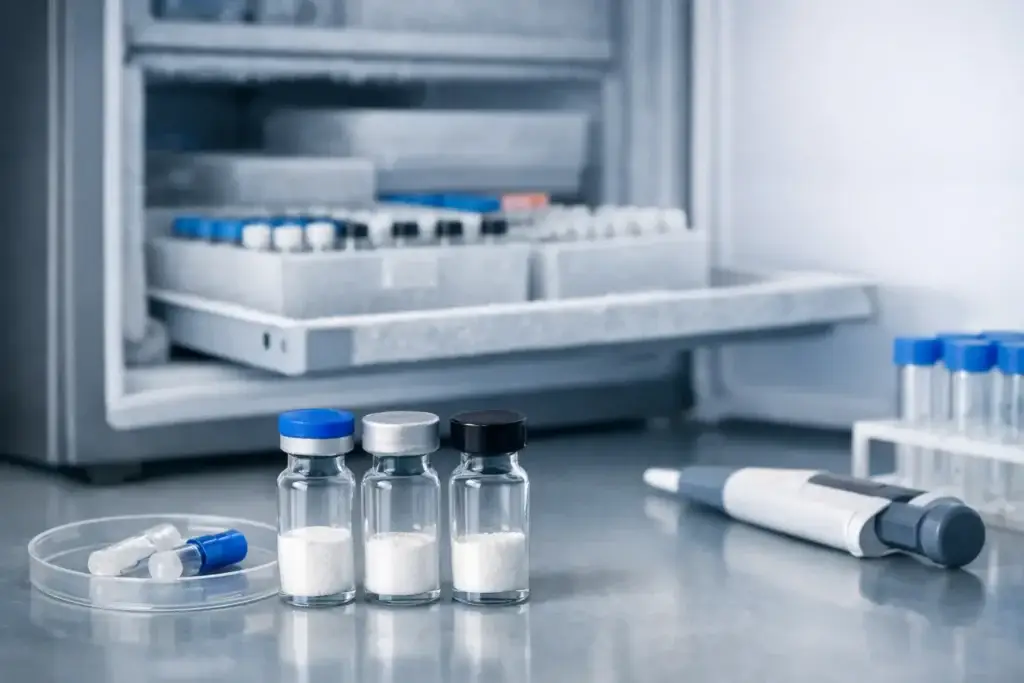
A research peptide can arrive with verified identity and purity, then lose practical value through avoidable handling errors at the bench. A freezer setpoint alone is not a storage program. Repeated temperature changes, moisture exposure, incomplete labeling, and poor inventory control can all introduce uncertainty before an experiment begins. Knowing how to store research peptides means protecting the material, preserving its documentation, and maintaining a record that supports confident laboratory use.
All research peptides should be handled strictly for laboratory research by qualified researchers. They are not intended for human or animal consumption, therapeutic use, or diagnostic use. Product-specific labeling and supplier documentation should always take priority over generalized handling guidance.
How to Store Research Peptides From the Moment They Arrive
Storage control begins at receipt, not when the vial is first opened. Inspect the shipment promptly and compare the product label, lot number, quantity, and condition of the package against the order record. If cold packs are no longer fully frozen, that fact alone does not necessarily indicate a product issue. What matters is the product-specific shipping configuration, transit duration, package condition, and any temperature requirements provided by the supplier.
Before placing a vial into long-term storage, confirm that its external label remains readable, then work through a consistent receipt check:
- Compare product name, lot number, and quantity against the order record.
- Inspect the vial and outer packaging for damage, cracked seals, or missing desiccant.
- Note the condition of any cold packs and the transit duration.
- Confirm the batch-specific COA matches the lot number on the vial.
- Log the receipt date, storage location, and any condition observations.
- Transfer the vial to its designated storage environment without delay.
Record the product name, lot number, date received, storage location, and any relevant condition observations in the laboratory inventory system. Retain the batch-specific Certificate of Analysis with the corresponding lot record. A COA supports verification of identity, purity, and consistency for that batch, but it does not replace appropriate storage and handling controls after receipt.
For unopened, lyophilized materials, minimize time at room temperature while completing inspection and logging. Avoid leaving vials on a bench while other receiving tasks are completed. Prompt, deliberate transfer to the designated storage environment reduces unnecessary exposure and makes it easier to maintain a clean chain of custody.
Match Storage Temperature to the Specific Peptide
There is no single freezer temperature that applies to every research peptide. Many lyophilized peptides are commonly maintained under frozen conditions for longer-term storage, often at approximately -20°C. Some materials, study designs, or retention periods may call for lower-temperature storage, such as -80°C. The correct choice depends on the peptide’s sequence, formulation, intended storage duration, supplier instructions, and the requirements of the research protocol.
The table below summarizes how these conditions are commonly discussed. It is orientation only — the product label always governs.
| Material state | Typical storage discussion | Primary risks to control |
|---|---|---|
| Unopened, lyophilized | Frozen storage, commonly around -20°C | Temperature cycling, moisture ingress |
| Lyophilized, extended retention | Lower-temperature storage such as -80°C where indicated | Freezer failure, incomplete records |
| Short-term working stock | Per product documentation and study protocol | Bench exposure, unclear labeling |
| Reconstituted solution | Governed by solvent, concentration, and validated hold time | Freeze-thaw cycles, undocumented hold time |
Use the product label and accompanying documentation as the controlling reference. If the product-specific instruction calls for refrigerated, frozen, or otherwise controlled conditions, do not substitute a general rule based on a different peptide. Similar-looking materials can have different stability profiles.
A dedicated laboratory freezer is generally preferable to a shared unit that is opened frequently or used for non-research items. Temperature cycling is a practical concern because it can occur even when the displayed freezer setpoint looks correct. Place vials away from the door and organize them in a defined rack, box, or compartment so they can be retrieved quickly without prolonged searching.
Temperature monitoring should be proportionate to the role of the material in the study. For higher-value inventory, longer storage periods, or work requiring strong traceability, use a monitored storage unit with documented alarm response procedures. A freezer failure is easier to investigate when records establish when the excursion occurred, what materials were affected, and what corrective action was taken.
Control Moisture, Condensation, and Light Exposure
Moisture is one of the most common avoidable risks for lyophilized peptide materials. Keep vials tightly sealed in their original container or in a clean secondary container that helps protect against humidity. If a supplier includes a desiccant or protective packaging intended for storage, retain it unless the product instructions state otherwise.
Let Vials Warm Before Opening
Condensation deserves particular attention. Do not open a cold vial immediately after removing it from frozen storage. Allow the sealed vial to reach room temperature before opening it. This reduces the chance that ambient moisture will condense inside the vial, where it may affect the lyophilized material and complicate subsequent handling.
Light sensitivity also varies by compound and formulation. When product instructions recommend protection from light, use an opaque secondary container or keep the vial in its original light-protective packaging. Even when light protection is not specifically required, storing materials away from direct light is a reasonable laboratory control.
These measures are simple, but they work together. A vial that remains cold, sealed, dry, and protected from unnecessary exposure is easier to manage consistently than one moved repeatedly between the freezer, bench, and shared storage areas.
Reconstituted Peptides Need a Separate Plan
Reconstitution changes the storage question. Once a peptide is in solution, its stability may depend on the solvent, concentration, pH, excipients, container type, temperature, and the number of freeze-thaw cycles. A storage approach appropriate for a dry, lyophilized vial may not be appropriate for the same material after reconstitution.
Follow the validated method or product-specific guidance for solvent selection, preparation conditions, storage temperature, and allowable hold time. If the study requires a solution to be retained, document the preparation date, preparer, solvent, concentration, lot number, and assigned expiration or retest date according to your laboratory procedure.
Aliquot to Limit Freeze-Thaw Cycles
Where the method supports it, aliquoting can reduce repeated handling of a larger reconstituted stock. Smaller, clearly labeled working portions limit the need to thaw and refreeze the same solution multiple times. However, aliquoting is not automatically the right approach for every peptide. It should be consistent with the research method, material compatibility, and available stability information.
Never infer a solution’s condition from appearance alone. A clear solution is not proof of identity, purity, or functional suitability. If an unexpected temperature excursion, contamination concern, labeling error, or extended hold time occurs, quarantine the material and evaluate it against the study’s acceptance criteria before using it.
Build Traceability Into Everyday Storage
Good peptide storage is also good documentation. Each vial or secondary container should remain linked to its original lot and supporting records. At a minimum, a laboratory should be able to answer which batch was used, where it was stored, when it was opened or reconstituted, and whether any deviations occurred.
What Belongs on a Storage Label
A clear storage label can include the material name, lot number, receipt date, storage condition, preparation date when applicable, and the initials of the responsible researcher. Avoid handwritten labels that become illegible at freezer temperatures or detach from the vial. Use labels designed for the storage environment and verify readability during routine inventory checks.
Physical organization matters just as much as labels. Establish a location convention that identifies the freezer, shelf, rack, box, and position. This reduces retrieval time, prevents accidental selection of the wrong vial, and supports efficient inventory reconciliation. For laboratories managing several peptide lots, first-expiring, first-out use can help reduce preventable waste, provided it remains consistent with the experimental plan.
Respond to Storage Deviations With Evidence, Not Assumptions
Power interruptions, freezer alarms, shipping concerns, and inadvertent bench exposure should be documented when they occur. Record the date, estimated duration, observed conditions, affected lots, and immediate action taken. Do not rely on memory after the fact.
The appropriate disposition depends on the nature of the excursion and the available product-specific stability information. A brief event may not have the same significance as a prolonged uncontrolled exposure, but neither should be dismissed without review. When evidence is insufficient to support continued use, segregate the material from active inventory until it can be assessed under laboratory procedures.
For researchers who rely on batch-specific documentation, this discipline protects more than a vial. It protects the interpretability of the resulting work. Independent testing and transparent COAs establish a strong starting point, while controlled storage preserves that confidence through the life of the material.
The most reliable storage system is the one researchers can follow every time: confirm the product requirement, limit exposure, maintain traceable records, and treat any uncertainty as a quality event worth documenting before it reaches the experiment.
Frequently Asked Questions
What temperature should research peptides be stored at?
There is no single answer. Lyophilized peptides are commonly held under frozen conditions, often around -20°C, with lower temperatures such as -80°C used for some materials or longer retention periods. The product label and supplier documentation govern, because sequence, formulation, and intended storage duration all affect the requirement.
Why should a vial warm up before it is opened?
Opening a cold vial lets ambient moisture condense inside it. Because moisture is one of the main avoidable risks to lyophilized material, allowing the sealed vial to reach room temperature first is a simple and effective control.
How long can a reconstituted peptide be stored?
That depends on solvent, concentration, pH, container, temperature, and freeze-thaw history, so it must follow the validated method or product-specific guidance rather than a general rule. Document the preparation date, solvent, concentration, lot number, and assigned retest date.
What should I do after a freezer failure?
Record the date, estimated duration, observed conditions, affected lots, and the action taken, then assess disposition against product-specific stability information. Where the evidence does not support continued use, segregate the material from active inventory pending review.
Does a COA mean storage does not matter?
No. A batch-specific COA establishes identity, purity, and consistency at the point of testing. It says nothing about how the material was handled afterward, which is why storage controls and traceable records remain necessary.